Getting into wildlife photography can feel overwhelming — expensive telephoto lenses, complicated autofocus settings, cameras with 47 menu pages. But here’s the thing: you don’t need top-tier gear to get compelling wildlife shots. The best affordable camera for wildlife photography for beginners is one that tracks animals reliably, shoots fast enough to freeze motion, and doesn’t require an engineering degree to operate. I’ve tested dozens of cameras in the field across Michigan — photographing everything from whitetail deer to bald eagles — and these seven give beginners the best start.
Quick Picks: Our Top 3 for Beginners
| Camera | Price | Why It’s Great for Beginners |
|---|---|---|
| Canon EOS R10 | ~$750 | Best AF for the money, easy to learn |
| Nikon Z50 II | ~$1,050 | Best IBIS + AF combo for beginners |
| Nikon Coolpix P950 | ~$800 | 83x zoom, no lens buying needed |
How We Chose These Cameras
For beginners, the evaluation criteria shift from what a pro would want. I prioritized: ease of use (intuitive menus, guided modes), animal autofocus (because manual focus on a moving fox is nearly impossible for beginners), built-in reach or affordable telephoto options, forgiving exposure systems, and price (leaving budget for a telephoto lens). Every camera here can produce wall-worthy wildlife images in the hands of someone who’s just starting out.
The 7 Best Beginner Wildlife Photography Cameras
1. Canon EOS R10 — Best Beginner Wildlife Camera Overall
The R10 is the camera I recommend most often to beginners getting into wildlife. Canon’s Dual Pixel CMOS AF II is shared with their $1,800+ R6 II body — meaning you get pro-level animal eye tracking at a budget price. The camera recognizes dogs, cats, birds, and horses, and locks onto eyes with eerie accuracy. At 15fps (23fps with electronic shutter crop), you’re capturing enough frames to get at least one sharp shot of a bird taking off.
Canon’s menus are the most beginner-friendly in the industry. The guided UI mode explains each setting in plain English, and the Auto mode is genuinely smart about exposure. The 24.2MP sensor produces detailed, clean files with Canon’s reliably pleasing color rendition — greens look green, not radioactive.
Key specs: 24.2MP APS-C, ISO 100-32,000, 15fps, animal/bird eye AF, 4K/30p, no IBIS, 429g, 430 shots/charge.
- Pros: Pro-level animal tracking AF, beginner-friendly menus, fast burst rate, lightweight, affordable — leaves budget for a telephoto
- Cons: No IBIS (image stabilization is lens-dependent), no weather sealing, limited buffer, single card slot
- Best for: Beginners who want the best AF system at the lowest price point
- Price: ~$750 body only
Recommended starter kit: R10 body ($750) + Canon RF 100-400mm f/5.6-8 IS ($650) = $1,400 total for a genuinely capable wildlife setup.
2. Nikon Z50 II — Best IBIS for Beginners
The Z50 II is Nikon’s answer to the R10, and it has one major advantage: in-body image stabilization. For beginners handholding a telephoto lens (which is most beginners, since tripods are a hassle to lug around), IBIS is transformative. It means your 250mm shots at 1/125s come out sharp instead of blurry. The EXPEED 7 processor brings subject-detection AF from Nikon’s Z8 and Z9, including bird and animal recognition.
Key specs: 20.9MP APS-C, ISO 100-51,200, 11fps, bird/animal AF, 4K/30p, IBIS, 550g, 350 shots/charge.
- Pros: IBIS for sharper handheld shots, subject-detection AF, lightweight, access to both Z-mount and F-mount lenses (via FTZ adapter)
- Cons: 20.9MP is lower resolution, only 11fps burst, shorter battery life, smaller EVF
- Best for: Beginners who shoot handheld and want stabilization built into the body
- Price: ~$1,050 body only
3. Nikon Coolpix P950 — Best All-in-One (No Extra Lenses Needed)
If the thought of buying separate lenses intimidates you, the P950 solves that problem entirely. Its built-in 24-2000mm equivalent zoom lens means you go from wide-angle landscapes to filling the frame with a bird 200 yards away — no lens changes, no extra purchases. For a true beginner who wants to start shooting wildlife today, this is the fastest path.
The trade-off is image quality. The 1/2.3″ sensor is much smaller than the APS-C cameras on this list, so high-ISO performance and dynamic range are noticeably weaker. But at base ISO in good light, the images are solid — especially given the incredible reach.
Key specs: 16MP 1/2.3″ CMOS, 24-2000mm f/2.8-6.5 lens, ISO 100-6,400, 7fps, 4K/30p, Dual Detect VR, 290 shots/charge.
- Pros: 83x zoom — no lens buying needed, simple operation, very affordable complete package, good stabilization
- Cons: Small sensor limits image quality, weak high-ISO performance, no interchangeable lenses means no upgrade path, slower AF
- Best for: Absolute beginners who want an all-in-one solution without buying lenses
- Price: ~$800
4. Sony a6400 — Best Budget Mirrorless with Pro AF
The a6400 is an older model, but it’s still remarkably competitive — and the price has dropped to around $900 since the a6700 launched. Sony’s real-time animal eye AF was groundbreaking when this camera released and it’s still effective. The 24.2MP APS-C sensor delivers clean files, and the huge E-mount lens selection means you’ll never run out of options. The no-blackout EVF at 11fps is nice for tracking fast-moving subjects.
Key specs: 24.2MP APS-C, ISO 100-32,000, 11fps with no viewfinder blackout, real-time animal eye AF, 4K/30p, no IBIS, 403g, 410 shots/charge.
- Pros: Proven animal eye AF, dropped to ~$900, huge lens ecosystem, compact body, no viewfinder blackout
- Cons: No IBIS, older menu system, no USB-C (micro-USB), getting harder to find new
- Best for: Beginners who want Sony’s AF system at the lowest possible price
- Price: ~$900 body only
5. Canon EOS R50 Mark II — Most Beginner-Friendly
The R50 Mark II is Canon’s smallest and lightest RF-mount body, and it’s designed with beginners in mind. The Creative Assist mode lets you adjust settings with visual sliders instead of cryptic numbers — sliding from “brighter” to “darker” instead of adjusting EV compensation. Animal detection AF works well for common wildlife, and the compact size means you’ll actually want to carry it.
Key specs: 24.2MP APS-C, ISO 100-32,000, 15fps electronic, animal detection AF, 4K/30p, no IBIS, 376g, 310 shots/charge.
- Pros: Most intuitive controls for beginners, ultra-lightweight, Canon’s excellent color science, Creative Assist mode
- Cons: No IBIS, no weather sealing, shorter battery life, limited physical controls for manual shooting
- Best for: Complete beginners who want the easiest possible learning curve
- Price: ~$800 body only
6. OM System OM-5 — Best Weatherproof Beginner Option
Wildlife doesn’t wait for sunny days, and the OM-5 doesn’t care about the weather. IP53 rating means rain, dust, and freezing temps won’t stop you. The 2x crop factor of Micro Four Thirds turns the affordable Olympus 75-300mm lens into a 150-600mm equivalent for just $400. For beginners in wet climates or anyone who shoots near water (rivers, marshes, coasts), the OM-5 is the safe choice.
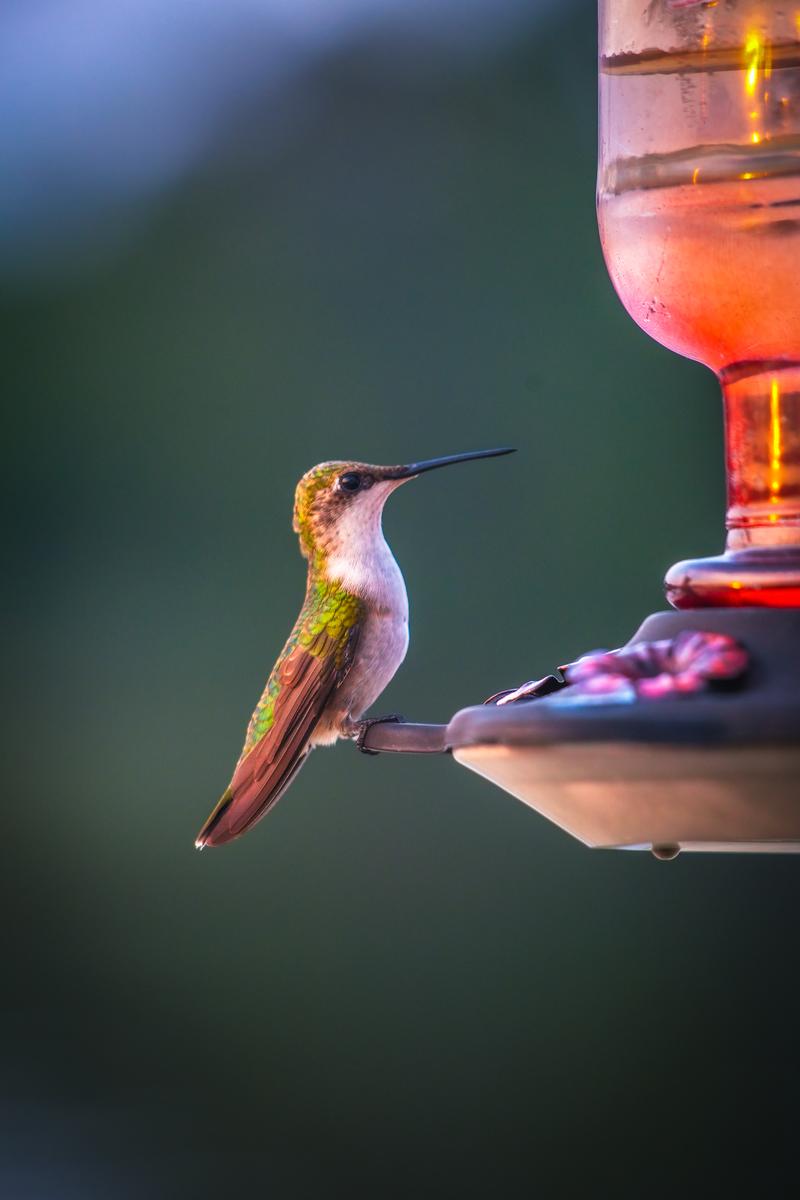
From the Photographer
Hummingbird Perched Iridescent Green
An iridescent green hummingbird paused between flights
Zeefeldt Photography
— Fine art prints starting at $95
Key specs: 20.4MP Micro Four Thirds, ISO 200-25,600, 10fps AF-C, bird/animal detection, 4K/30p, 7-stop IBIS, IP53 rated, 414g, 310 shots/charge.
- Pros: IP53 weatherproofing, incredible IBIS, 2x crop for telephoto reach, compact system overall, Pro Capture mode (buffers frames before shutter press)
- Cons: Smaller sensor limits low-light shooting, 20.4MP is modest, M4/3 ecosystem is shrinking
- Best for: Beginners who shoot in bad weather or need maximum telephoto reach on a budget
- Price: ~$1,200 body only
7. Nikon Z30 — Best Under $600
At ~$500 body-only, the Z30 is the most affordable interchangeable-lens camera on this list. No EVF (screen-only), no IBIS — it’s stripped down. But the 20.9MP sensor is the same proven unit from the Z50 line, subject-detection AF works for animals and birds, and you get full Z-mount compatibility. Add the Nikon Z DX 50-250mm ($300) and you have a complete wildlife starter kit for $800.
Key specs: 20.9MP APS-C, ISO 100-51,200, 11fps, animal/bird AF, 4K/30p, no EVF, no IBIS, 405g, 330 shots/charge.
- Pros: Most affordable interchangeable-lens option, full Z-mount compatibility, decent AF, compact and light
- Cons: No EVF, no IBIS, no weather sealing, screen can be hard to see in bright sun
- Best for: Absolute budget beginners who want an upgradeable system
- Price: ~$500 body only
Comparison Table
| Camera | Resolution | Burst Rate | Animal AF | IBIS | Weather Sealed | Price |
|---|---|---|---|---|---|---|
| Canon EOS R10 | 24.2MP | 15fps | Yes | No | No | $750 |
| Nikon Z50 II | 20.9MP | 11fps | Yes | Yes | Partial | $1,050 |
| Nikon P950 | 16MP | 7fps | Basic | Lens VR | No | $800 |
| Sony a6400 | 24.2MP | 11fps | Yes | No | Partial | $900 |
| Canon R50 II | 24.2MP | 15fps | Yes | No | No | $800 |
| OM System OM-5 | 20.4MP | 10fps | Yes | Yes (7-stop) | IP53 | $1,200 |
| Nikon Z30 | 20.9MP | 11fps | Yes | No | No | $500 |
Beginner’s Buyer’s Guide: What Matters Most
Autofocus is King
For wildlife photography, autofocus is the most important feature — period. Animals move unpredictably, and if your camera can’t track a bird in flight or a running deer, you’ll miss the shot regardless of everything else. Prioritize cameras with dedicated animal/bird eye detection over raw specs like megapixels.
Reach Matters More Than Resolution
A 20MP camera with a 400mm lens will produce better wildlife images than a 50MP camera with a 100mm lens. Invest in reach — either through a telephoto lens or a high-crop-factor system. The longest affordable telephoto lenses in the $500-$700 range will transform your wildlife photography.
Start Simple, Upgrade Later
Buy a capable body at a reasonable price and invest the savings in a good telephoto lens. As your skills grow, you can upgrade the body while keeping your lens collection. The lens ecosystem you buy into now will determine your upgrade path for years.
Frequently Asked Questions
What focal length do I need for wildlife photography?
At minimum, 300mm equivalent. Ideally 400-600mm. On an APS-C camera, a 100-400mm lens gives you 150-600mm equivalent reach. For birds specifically, 500mm+ equivalent is where you start getting frame-filling shots from a reasonable distance.
Do I need a tripod for wildlife photography?
Not necessarily when starting out. A monopod is lighter and faster to set up. For long telephoto lenses (500mm+), some support is helpful. IBIS-equipped cameras like the Nikon Z50 II and OM System OM-5 help a lot with handheld stability. Start handheld and add support as needed.
What camera settings should beginners use for wildlife?
Start with Aperture Priority (A or Av mode), set your aperture wide open (lowest f-number), enable continuous AF with animal tracking, and set burst mode to high. Let the camera handle shutter speed and ISO. A minimum shutter speed of 1/500s is a good starting point for moving animals, 1/1000s or faster for birds in flight.
Can I use a kit lens for wildlife photography?
An 18-55mm kit lens is too short for most wildlife. An 18-150mm or 55-250mm kit telephoto is usable for larger animals at moderate distances, but you’ll quickly want more reach. Budget for a 100-400mm class lens as your next purchase — it’s the single biggest upgrade you can make.
Is the Canon R10 or Nikon Z50 II better for a beginner?
Both are excellent. The Canon R10 has faster burst rate (15fps vs 11fps) and more affordable telephoto options in the RF-mount system. The Nikon Z50 II has IBIS, which is a big advantage for handheld shooting. If you shoot handheld a lot, go Nikon. If burst speed matters more, go Canon. You won’t regret either choice.
Final Verdict
For most beginners, the Canon EOS R10 is the best starting point. At $750, it delivers pro-level autofocus, fast burst shooting, intuitive menus, and Canon’s excellent color. Pair it with the RF 100-400mm IS lens and you have a wildlife photography setup that will grow with you for years.
If handheld stabilization is important to you, the Nikon Z50 II with its built-in IBIS is worth the extra $300.
And if you just want to start shooting wildlife right now without worrying about lenses, the Nikon P950 with its insane 83x zoom gets you in the game immediately.
The best affordable camera for wildlife photography for beginners is the one that gets you out in the field, shooting. Pick one, learn it, and let the animals do the rest.