Aerial photography transforms ordinary landscapes into extraordinary compositions. Whether you’re shooting real estate, nature, or travel content, the best budget drone for aerial photography puts a capable camera in the sky without draining your bank account. I’ve spent years shooting Michigan’s coastlines and forests from above — here are the drones that deliver the best aerial photos for the money.
Quick Picks: Best Budget Drones for Aerial Photography
| Drone | Best For | Price Range |
|---|---|---|
| DJI Mini 4 Pro | Best overall for photos | ~$759 |
| DJI Air 3 | Best dual-camera | ~$1,099 |
| DJI Mini 3 | Best entry-level | ~$449 |
How We Evaluated
For aerial photography specifically, I weighted photo resolution (megapixels and sensor size), RAW capture support, dynamic range for challenging aerial lighting, stability in wind, obstacle avoidance for safe operation near structures, and overall portability. Video specs were secondary — this is about getting the best aerial stills.
Best Overall: DJI Mini 4 Pro
The DJI Mini 4 Pro is purpose-built for aerial photography excellence. The 48MP mode on its 1/1.3-inch sensor captures incredible detail from altitude — enough to crop aggressively and still make large prints. True vertical shooting mode means you can capture portrait-oriented aerials perfect for social media and vertical prints.
Key Specs: 1/1.3″ CMOS, 48MP photos, RAW (DNG), 34-min flight, omnidirectional obstacle sensing, HDR photo mode, 249g.
Pros: 48MP high-resolution mode reveals incredible ground detail, RAW DNG files with good dynamic range, HDR mode for high-contrast scenes, vertical shooting without post-crop, under 249g for easy flying.
Cons: Single focal length limits composition variety, small sensor still lags behind 1-inch sensors in dynamic range, moderate wind resistance, requires RC 2 controller for full features.
Best For: Landscape and nature photographers who want a drone primarily for aerial stills. The 48MP mode at under $800 is the best photo-to-price ratio in consumer drones.
Best Dual Camera: DJI Air 3
The DJI Air 3 changes aerial photography by giving you two perspectives without landing. The 24mm wide-angle captures sweeping landscapes, then switch to the 70mm telephoto for compressed, intimate aerial compositions. Both sensors shoot 48MP RAW. This versatility is a massive advantage for photography.
Key Specs: Dual 1/1.3″ sensors, 48MP (both cameras), 24mm + 70mm equiv, 46-min flight, omnidirectional obstacle avoidance, 720g.
Pros: Two focal lengths open creative possibilities no single-camera drone can match, 46-minute flights mean more time composing shots, both cameras shoot 48MP RAW, better wind resistance than Mini series.
Cons: Requires FAA registration, larger and heavier for hiking, more expensive, neither camera has a 1-inch sensor.
Best For: Photographers who want maximum creative flexibility from the air. The 70mm telephoto creates unique aerial perspectives — compressed treelines, isolated lake details, tight architectural shots — that wide-angle-only drones simply can’t achieve.
Best Entry-Level: DJI Mini 3
At under $450, the DJI Mini 3 is the most affordable way to get quality aerial photos. The 12MP camera (with 48MP binning available) shoots RAW and handles good-light conditions admirably. If you’re testing whether aerial photography fits your workflow, this is where to start.
Key Specs: 1/1.3″ sensor, 12MP default / 48MP pixel-binned, RAW support, 38-min flight, 249g, no obstacle avoidance.
Pros: Under $450, sub-249g, surprisingly good photo quality in daylight, RAW support for editing flexibility, vertical shooting mode, long battery life.
Cons: No obstacle avoidance (requires careful piloting), 12MP default is lower resolution, fewer automated shooting modes, basic controller.
From the Photographer
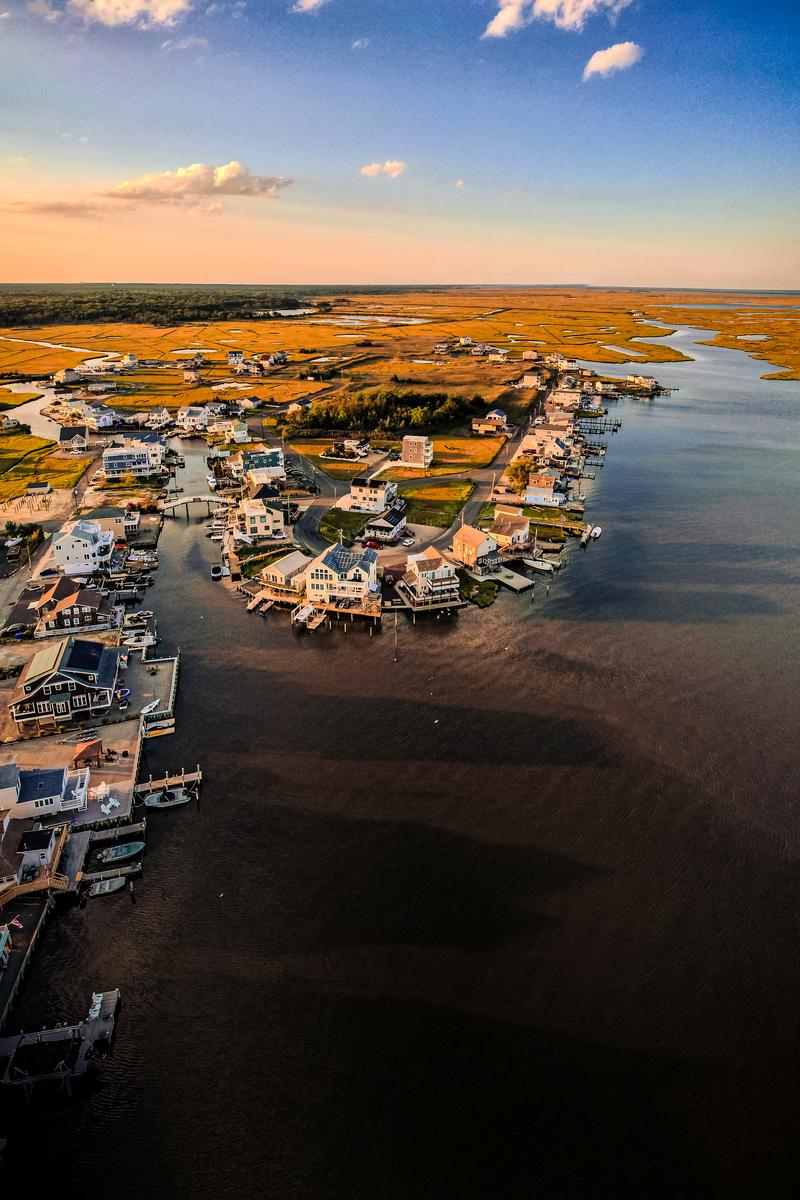
Aerial Coastal Town Sunset
A coastal town glowing at sunset — captured from above
Zeefeldt Photography
— Fine art prints starting at $95
Best For: Photographers exploring aerial photography who don’t want to invest $750+ before knowing if they’ll use it regularly. Excellent for learning aerial composition and technique.
What About Non-DJI Options?
Autel EVO Nano+ (~$799)
The Autel EVO Nano+ is the strongest non-DJI competitor in this price range. Its 1/1.28-inch CMOS sensor with 50MP RYYB capture actually out-resolves the DJI Mini 4 Pro on paper. However, DJI’s software ecosystem, intelligent flight modes, and obstacle avoidance are generally more polished. The Autel is worth considering if you want an alternative to DJI’s dominance.
Buyer’s Guide: Aerial Photography Essentials
Shooting in RAW Is Non-Negotiable
Always shoot RAW (DNG) for aerial photography. Drone sensors are smaller than camera sensors and benefit enormously from RAW processing. You can recover 2-3 stops of highlight and shadow detail that JPEG simply discards. Every drone on this list supports RAW — use it.
Golden Hour Is Your Best Friend
Aerial photography is all about light. The long shadows and warm tones of golden hour (30 minutes after sunrise, 30 minutes before sunset) create dramatic depth and dimension that midday light can’t match. Plan your flights around golden hour for the most compelling results.
Composition From Above
Aerial composition follows different rules than ground photography. Look for patterns (rows of trees, winding rivers, geometric farmland), leading lines from roads or shorelines, and the interplay of light and shadow. Shooting directly down (nadir) creates abstract graphic compositions. Shooting at 30-45° angles gives depth and context.
Frequently Asked Questions
What is the best budget drone for aerial photography?
The DJI Mini 4 Pro offers the best balance of photo quality, safety features, and price for aerial photography. Its 48MP camera with RAW support, omnidirectional obstacle avoidance, and sub-249g weight make it the default recommendation at around $759.
Do I need a license to fly a photography drone?
For recreational flying in the US, no license is required — but you must follow FAA rules (below 400 feet, visual line of sight, away from airports). For commercial aerial photography (selling the photos), you need an FAA Part 107 Remote Pilot Certificate, which requires passing a knowledge test.
Can drone photos be sold as prints?
Absolutely. Modern drone photos at 48MP produce files large enough for prints up to 30×40 inches or larger. Aerial perspectives are popular as wall art — coastlines, autumn forests, and geometric patterns from above sell well. I sell aerial prints from my Michigan shooting alongside my ground-based landscape work.
What’s the best time of day for aerial photography?
Golden hour (30 minutes after sunrise or before sunset) produces the most dramatic aerial photos due to long shadows and warm light. Blue hour (just before sunrise or after sunset) creates moody, atmospheric shots. Midday works for graphic overhead compositions but lacks the depth of angled light.
How do I get sharp aerial photos?
Use a fast shutter speed (1/500s or faster) to counteract drone movement, shoot in RAW for maximum quality, use the lowest ISO possible, and hover steadily before triggering the shutter. Enable the 2-second timer to let vibrations settle. For critical shots, use AEB (auto exposure bracketing) and merge in post.
Final Verdict
The DJI Mini 4 Pro is the best budget drone for aerial photography — 48MP photos, RAW capture, obstacle avoidance, and sub-249g convenience. Step up to the Air 3 for dual-camera versatility, or start with the Mini 3 at under $450 to explore aerial photography without a major investment.