
Bird photography is one of the most demanding genres in nature photography. Your subjects are small, fast, unpredictable, and rarely cooperative. Getting a sharp, well-exposed photo of a bird in flight requires a camera with exceptional autofocus, fast burst rate, and enough resolution to crop when the bird isn’t filling the frame. The best bird photography camera for beginners needs to nail these basics without requiring years of experience to operate.
I’ve spent countless hours at Michigan’s Kensington Metropark and Tawas Point Birding Trail photographing warblers, herons, and raptors. Here’s what This guide recommends for beginners breaking into bird photography in 2026.
Quick Picks: Top 3 Bird Photography Cameras for Beginners
| Camera | Why It Stands Out | Price |
|---|---|---|
| Sony a6700 | Best overall, bird-eye detection AF, 11fps, excellent reach with APS-C crop | ~$1,398 |
| Fujifilm X-T50 | Highest resolution. 40.2MP lets you crop aggressively | ~$1,399 |
| Canon EOS R50 | Best budget, reliable bird AF, ultra-lightweight for long sessions | ~$679 |
What Makes a Good Bird Photography Camera?
Bird photography demands more from your camera than any other nature discipline. Here’s what matters most:
Autofocus with bird/eye detection: Modern AI-powered autofocus can identify a bird’s eye and lock onto it, even when the bird is small in the frame. This is game-changing for beginners who don’t have the skill to manually track a bird across AF points.
Burst rate: Birds move constantly, flapping, turning, diving. Shooting 8-12 frames per second dramatically increases your chances of catching the perfect wing position or expression.
Buffer depth: How many continuous shots can the camera take before it slows down to write files? Shallow buffers (under 30 RAW frames) are frustrating when tracking a bird in flight.
Reach factor: APS-C sensors give you a 1.5x crop factor, effectively turning a 400mm lens into 600mm. For bird photography, this extra reach is a significant advantage over full-frame.
Detailed Reviews
1. Sony a6700. Best Overall Bird Camera for Beginners
The Sony a6700 has the best autofocus system available in an APS-C camera, period. The real-time bird eye detection AF locks onto a bird’s eye and tracks it continuously, even as the bird flies erratically, turns its head, or partially hides behind branches. The 759-point phase-detect AF covers 93% of the frame, so you don’t need to precisely aim a center point.
Key specs: 26MP APS-C, 759-point PDAF, bird/animal/insect eye detection, 11fps mechanical, 5-axis IBIS, 4K 120p, weather-sealed, 17.0 oz.
Pros: Industry-leading bird eye AF, 1.5x crop factor for extra reach, IBIS helps with handheld telephoto shooting, deep buffer (59 compressed RAW), robust weather sealing for wetland environments.
Cons: 11fps is good but not class-leading, single card slot, viewfinder could be larger for tracking fast birds.
Best lens pairings: Sony 70-350mm f/4.5-6.3 G ($748), lightweight, sharp, and affordable. For more serious work: Sony 200-600mm f/5.6-6.3 G ($1,998), the gold standard for bird photography on APS-C.
Price: ~$1,398 body only
2. Fujifilm X-T50. Best Resolution for Bird Cropping
Birds are small and often far away. The Fujifilm X-T50‘s 40.2MP sensor lets you crop to 50% and still have a 20MP image, that’s like having an extra 1.4x teleconverter for free. Combined with the 1.5x APS-C crop factor, you get incredible reach from relatively compact lenses.
Key specs: 40.2MP APS-C X-Trans, 20fps electronic shutter, bird/animal detection AF, IBIS, 14.6 oz.
Pros: 40.2MP gives unmatched cropping latitude, 20fps electronic shutter catches fast action, IBIS for handheld stability, beautiful Fujifilm color science for natural bird plumage rendition.
Cons: Bird AF tracking isn’t as reliable as Sony’s in challenging conditions, 20fps with electronic shutter introduces rolling shutter on fast-moving wings, XF telephoto lenses are pricier.
Best lens pairings: Fujifilm XF 70-300mm f/4-5.6 R LM OIS ($799) or XF 150-600mm f/5.6-8 R LM OIS ($1,999).
Price: ~$1,399 body only
3. Canon EOS R50. Best Budget Bird Camera
Canon’s EOS R50 brings bird-specific autofocus to a $679 body. The Dual Pixel CMOS AF II system detects birds, including eyes and full body, and tracks them across the frame. At 12fps with the mechanical shutter and 15fps electronic, you get solid burst performance for the price.
Key specs: 24.2MP APS-C, Dual Pixel CMOS AF II, bird/animal detection, 12fps mechanical / 15fps electronic, no IBIS, 13.1 oz.
Pros: Bird detection AF at the lowest price point, extremely lightweight for long birding sessions, Canon RF-S 55-210mm ($349) is an affordable telephoto option, excellent for learning.
Cons: No IBIS means handholding heavy telephotos is harder, limited buffer depth (~9 RAW before slowing), no weather sealing, autofocus tracking is less reliable than Sony or Canon R7.
Best lens pairings: Canon RF-S 55-210mm f/5-7.1 IS STM ($349) for casual birding; Canon RF 100-400mm f/5.6-8 IS USM ($649) for serious work.
Price: ~$679 body only
4. Canon EOS R7. Best Serious Beginner Bird Camera
If you’re committed to bird photography specifically, the Canon EOS R7 is the purpose-built APS-C bird body. With 15fps mechanical shutter (30fps electronic), the deepest AF system Canon puts in an APS-C camera, and a 32.5MP sensor for excellent cropping, it’s a step above the R50 in every meaningful way for bird work.
Key specs: 32.5MP APS-C, Dual Pixel CMOS AF II, 15fps mechanical / 30fps electronic, 5-axis IBIS, weather-sealed, 21.2 oz.
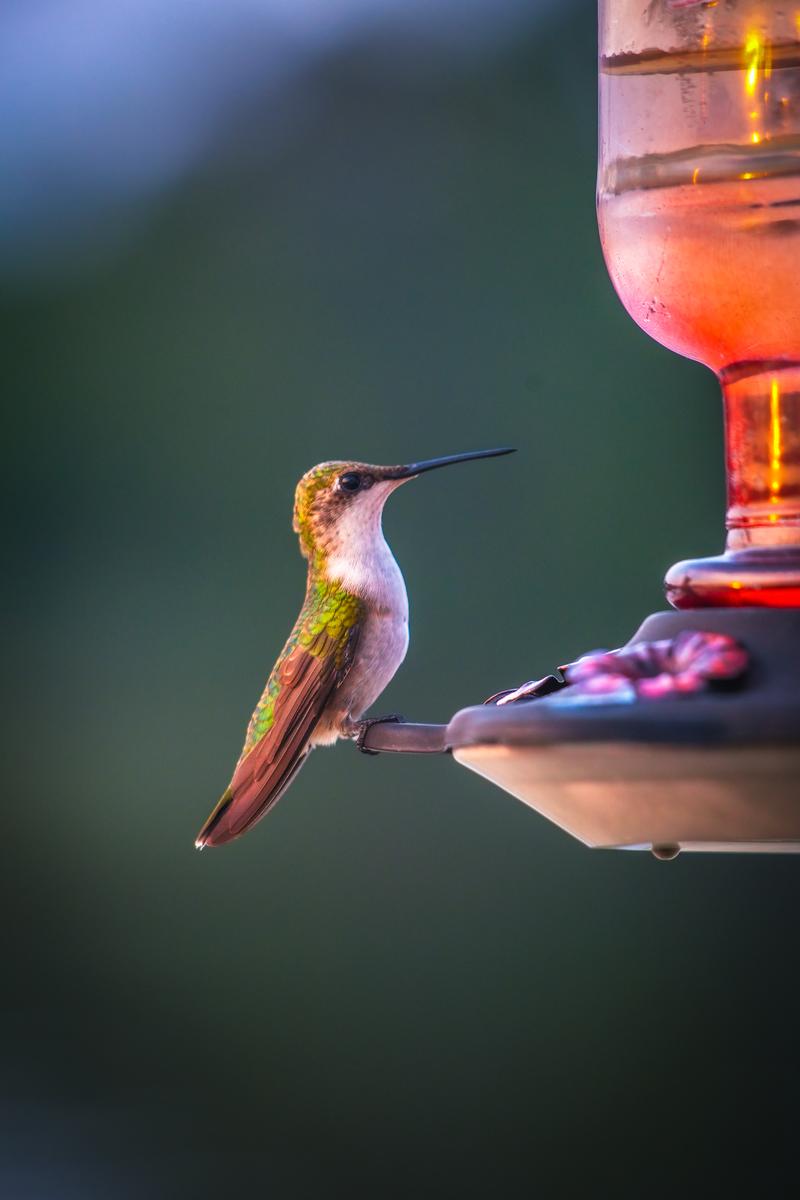
From the Photographer
Hummingbird Perched Iridescent Green
An iridescent green hummingbird paused between flights
Zeefeldt Photography
. Fine art prints starting at $95
Pros: 15fps mechanical shutter (no rolling shutter on wings), IBIS for handheld telephoto, deeper buffer than R50, weather-sealed for marshland/wetland shooting, 32.5MP for generous cropping.
Cons: More expensive ($1,499), heavier than other options, Canon’s bird AF still trails Sony’s in erratic-movement tracking, rolling shutter in 30fps electronic mode.
Price: ~$1,499 body only
5. Nikon Z50 II. Best for Birding on a Budget (Nikon System)
If you’re already invested in Nikon or prefer their ergonomics, the Nikon Z50 II handles bird photography surprisingly well. The bird detection AF is competent (though not Sony-level), and Nikon’s DX 50-250mm is one of the sharpest budget telephoto zooms available at just $397.
Key specs: 20.9MP APS-C, hybrid PDAF with bird detection, 11fps, no IBIS, 14.6 oz.
Pros: Excellent ergonomics for long shooting sessions, Nikon Z DX 50-250mm is sharp and cheap, comfortable handling, natural color rendition for bird plumage.
Cons: 20.9MP limits aggressive cropping, no IBIS, bird AF is good but not best-in-class, limited DX telephoto options beyond 250mm.
Price: ~$1,097 with kit lens
Comparison Table
| Camera | MP | Bird AF | Burst Rate | IBIS | Weight | Price |
|---|---|---|---|---|---|---|
| Sony a6700 | 26 | Excellent | 11fps | Yes | 17.0 oz | $1,398 |
| Fujifilm X-T50 | 40.2 | Good | 20fps (e) | Yes | 14.6 oz | $1,399 |
| Canon EOS R50 | 24.2 | Good | 15fps (e) | No | 13.1 oz | $679 |
| Canon EOS R7 | 32.5 | Very Good | 15fps (m) | Yes | 21.2 oz | $1,499 |
| Nikon Z50 II | 20.9 | Decent | 11fps | No | 14.6 oz | $1,097 |
Buyer’s Guide: Choosing a Bird Photography Setup
APS-C vs. Full-Frame for Birds
For bird photography, APS-C is actually preferable to full-frame for beginners. The 1.5x crop factor gives you extra reach, a 400mm lens on APS-C gives the same field of view as a 600mm on full-frame. Since long telephoto lenses are expensive, this free reach bonus is worth thousands of dollars in equivalent lens cost.
The Lens Matters More Than the Body
A $679 Canon R50 with a $649 RF 100-400mm lens will produce better bird photos than a $2,000 camera body with a $200 kit telephoto. Budget at least 50% of your total spend on the telephoto lens. Look for lenses with fast, quiet autofocus motors (STM, USM, or linear motors), noisy focusing can scare birds.
Recommended Budget Telephoto Lenses
Sony: Sony 70-350mm f/4.5-6.3 G ($748), best value
Canon: Canon RF 100-400mm f/5.6-8 IS USM ($649), lightest 400mm
Nikon: Nikon Z DX 50-250mm f/4.5-6.3 ($397), cheapest entry point
Fujifilm: Fujifilm XF 70-300mm f/4-5.6 ($799), sharpest budget option
Many bird photographers are switching to mirrorless for the faster autofocus, see our best budget mirrorless camera for wildlife photography guide for top picks.
Frequently Asked Questions
What is the best camera for bird photography for beginners?
The Sony a6700 is the best overall choice for beginner bird photographers. Its bird-eye detection autofocus is the most reliable in the APS-C class, and the 1.5x crop factor provides extra telephoto reach. For budget-conscious beginners, the Canon EOS R50 at $679 offers capable bird detection AF.
Do I need a super telephoto lens for bird photography?
At minimum, you need 300-400mm of focal length (APS-C equivalent). For small or distant birds, 500-600mm is preferable. Start with a 70-350mm or 100-400mm zoom, then consider a dedicated super telephoto like the Sony 200-600mm as your skills progress.
Is the 1.5x crop factor advantage for bird photography?
Yes. APS-C sensors effectively multiply your lens focal length by 1.5x, giving you extra reach without additional lens cost or weight. A 400mm lens on APS-C gives the same field of view as a 600mm on full-frame, which is a significant advantage for bird photography.
What settings should I use for bird photography?
Start with Shutter Priority (S/Tv mode) at 1/2000s or faster for birds in flight, 1/500s for perched birds. Use Auto ISO with a maximum of 6400-12800. Set your AF to continuous tracking with bird/animal detection enabled. Shoot in burst mode.
How much does a bird photography setup cost?
A capable beginner setup starts around $1,030 (Canon R50 at $679 + RF-S 55-210mm at $349). A more serious setup runs $2,100-2,400 (Sony a6700 at $1,398 + 70-350mm at $748). Budget at least 40-50% of your total spend on the telephoto lens.
Final Verdict
The best bird photography camera for beginners is the Sony a6700. Its bird-eye detection autofocus is genuinely transformative, the camera does the hard work of finding and tracking the bird while you focus on composition. Pair it with the Sony 70-350mm f/4.5-6.3 G ($748) and you have a system that will serve you well from backyard feeders to serious birding excursions.
On a budget, the Canon EOS R50 at $679 delivers bird detection AF at a remarkably low price point. And if resolution for cropping is your top priority, the Fujifilm X-T50‘s 40.2MP sensor is unmatched.
Browse more nature photography tutorials, gear reviews, and field tips.
Download our guide: exposure, ISO, and aperture strategies for every light condition and terrain.
We respect your inbox. One guide, occasional tips, unsubscribe anytime.
Related Guides
 How to Photograph Birds in Flight: Settings, Autofocus & Fieldcraft
 Best Digiscoping Adapters for Wildlife Photography (2026): 6 Picks for Extreme Reach on a Budget
 Best Camera Hides for Wildlife Photography (2026): 5 Portable Blinds for Getting Close
 Best Window Mounts for Wildlife Photography (2026): 5 Picks for Vehicle-Based Shooting