
You don’t need to drop $3,000 on a camera body to get stunning landscape images. The best affordable camera for landscape photography is the one that nails dynamic range, delivers clean files at base ISO, and doesn’t weigh you down on a 10-mile trail. Here are seven picks, all under $1,500.
Quick Picks: Top 3 at a Glance
| Camera | Price | Best For |
|---|---|---|
| Nikon Z50 II | ~$1,050 | Best overall value |
| Canon EOS R50 Mark II | ~$800 | Lightweight trail camera |
| Fujifilm X-T5 | ~$1,400 | Best image quality under $1,500 |
How We Evaluated These Cameras
Every camera on this list was evaluated against what actually matters for landscape work: dynamic range (can it handle a bright sky and dark foreground?), resolution (enough detail for large prints), weather sealing (because you’ll be out in rain, dust, and cold), weight (long hikes demand light gear), and lens ecosystem (great bodies are useless without great glass). Battery life also counts, since there is nothing worse than a dead camera at sunset.
The 7 Best Affordable Cameras for Landscape Photography
1. Nikon Z50 II. Best Overall Value
The Z50 II is Nikon’s updated APS-C mirrorless body and it punches way above its price. The 20.9MP sensor delivers excellent dynamic range. It will take 3+ stops of shadow lifting in post with minimal noise. The EXPEED 7 processor gives you snappy autofocus (even though landscape shooters mostly use manual focus with focus peaking). At just 550g with the kit lens, it’s light enough for all-day hikes.
Key specs: 20.9MP APS-C CMOS, ISO 100-51,200, 11fps burst, 4K/30p video, 3.2″ tilting touchscreen, USB-C charging, 350 shots per charge.
- Pros: Excellent dynamic range for APS-C, lightweight, access to Nikon Z-mount glass (including FTZ adapter for F-mount), USB-C in-field charging, strong IBIS
- Cons: APS-C crop factor means wider lenses needed, EVF could be larger, battery life is average
- Best for: Hikers who want Nikon’s lens ecosystem without the full-frame weight
- Price: ~$1,050 body only
2. Canon EOS R50 Mark II. Best Lightweight Option
At just 376g body-only, the R50 Mark II is the lightest camera on this list. Canon updated it with a 24.2MP APS-C sensor and improved DIGIC X processing. The autofocus is superb, inherited from Canon’s higher-end R-series, though for landscapes you’ll mostly be at f/8 to f/11 with manual focus anyway. Where this camera shines is portability. Pair it with Canon’s RF-S 18-150mm and you’ve got a do-everything trail setup under 700g.
Key specs: 24.2MP APS-C CMOS, ISO 100-32,000, 15fps electronic shutter, 4K/30p, 2.95″ vari-angle touchscreen, Wi-Fi/Bluetooth, 310 shots per charge.
- Pros: Incredibly compact and light, excellent Canon RF/RF-S lens selection, great color science, reliable vari-angle screen for low compositions
- Cons: No weather sealing, smaller battery, no in-body stabilization, single SD card slot
- Best for: Ultralight backpackers and casual landscape shooters who prioritize portability
- Price: ~$800 body only
3. Fujifilm X-T5. Best Image Quality Under $1,500
The X-T5 packs a 40.2MP APS-C sensor, the highest resolution on this list by a wide margin. That means massive detail for large prints. X-T5 files hold up at 30×40″ and stay razor sharp. The dedicated dials for shutter speed, ISO, and exposure compensation give it a tactile, manual feel that landscape photographers love. Fuji’s film simulation modes (Velvia, Provia, Astia) produce gorgeous straight-out-of-camera JPEGs that look like slide film.
Key specs: 40.2MP APS-C X-Trans CMOS 5 HR, ISO 125-12,800, 15fps mechanical shutter, 6.2K/30p video, 3.0″ tilting LCD, IBIS (up to 7 stops), 580 shots per charge.
- Pros: 40MP resolution for massive prints, outstanding IBIS, beautiful film simulations, weather-resistant body, retro controls
- Cons: At $1,400 it’s the priciest on this list, Fuji XF lenses can be expensive, X-Trans sensor confuses some raw processors
- Best for: Print-makers who want maximum resolution and love manual controls
- Price: ~$1,400 body only
4. Sony a6700. Best Hybrid Shooter
If you want to shoot both stills and video on location, the a6700 is tough to beat. The 26MP APS-C sensor with Sony’s latest BIONZ XR processor delivers clean files with impressive dynamic range. Sony’s real-time autofocus tracking is the best in class, though for tripod-mounted landscapes that’s less important. What matters here is the 5-axis IBIS (up to 5 stops), solid weather sealing, and access to Sony’s enormous E-mount lens library.
Key specs: 26MP APS-C Exmor R CMOS, ISO 100-32,000, 11fps, 4K/120p video, 3.0″ vari-angle touchscreen, 5-axis IBIS, 570 shots per charge.
- Pros: Best-in-class autofocus, strong video specs, huge E-mount lens selection, good weather sealing, USB-C charging
- Cons: Sony menus have a learning curve, 26MP is middle-of-the-road, body design is utilitarian
- Best for: Photographers who also create video content of their trips
- Price: ~$1,400 body only
5. Nikon Z5 (Refurbished). Best Full-Frame Value
Here’s a secret: you can get into full-frame for under $1,000 if you buy a refurbished Nikon Z5. The 24.3MP full-frame sensor delivers noticeably better dynamic range and high-ISO performance than any APS-C camera. The Z5’s 5-axis IBIS is solid, the body is weather-sealed, and it takes the same Z-mount lenses as Nikon’s $2,500+ bodies. For landscape-specific work where you’re mostly at ISO 100 on a tripod, this camera produces files that rival cameras twice its price.
Key specs: 24.3MP full-frame CMOS, ISO 100-51,200, 4.5fps, 4K/30p (cropped), 3.2″ tilting touchscreen, dual SD card slots, 5-axis IBIS, 470 shots per charge.
- Pros: Full-frame sensor under $1,000 refurbished, excellent dynamic range, dual card slots, weather sealed, Z-mount compatibility
- Cons: Older EXPEED 6 processor (slower AF), only 4.5fps burst, 4K video is cropped, limited availability new
- Best for: Landscape purists who want full-frame dynamic range on a budget
- Price: ~$800-$1,000 refurbished
6. OM System OM-5. Best for Bad Weather
If you shoot in rain, snow, or dusty desert conditions regularly, the OM-5 is built for it. This thing is IP53 rated, meaning it handles splashes and dust without flinching. The Micro Four Thirds sensor is smaller than APS-C, which means slightly less dynamic range, but the trade-off is incredible IBIS (up to 7 stops handheld), a compact body, and access to OM System’s excellent weather-sealed lenses. The built-in computational photography modes (Live Composite, High Res Shot) are genuinely useful for landscapes.
Key specs: 20.4MP Micro Four Thirds Live MOS, ISO 200-25,600, 10fps, 4K/30p, 3.0″ vari-angle touchscreen, IP53 weather rating, 310 shots per charge.
- Pros: Best weather sealing in class, incredible IBIS, compact/lightweight system, Live Composite for long exposures, High Res Shot for 50MP files
- Cons: Smaller sensor limits dynamic range and high-ISO performance, 20MP is low for large prints, Micro Four Thirds market is niche
- Best for: Foul-weather landscape shooters and those who want computational photography tools
- Price: ~$1,200 body only
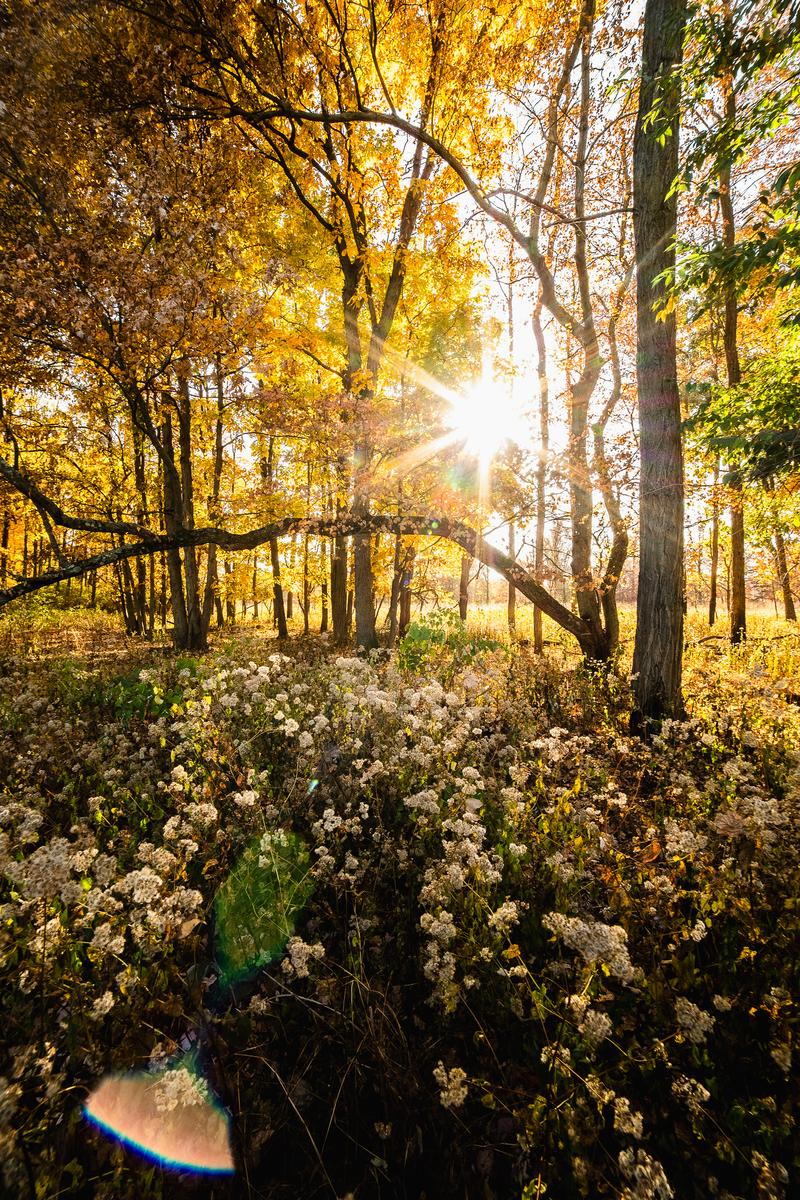
From the Photographer
Golden Autumn Forest Sunburst
Golden light breaking through an autumn forest canopy
Zeefeldt Photography
. Fine art prints starting
7. Canon EOS R10. Best Entry-Level Enthusiast
The R10 sits just below the R50 II in Canon’s lineup but offers a more serious body with better ergonomics, a deeper grip, and a proper electronic viewfinder. The 24.2MP APS-C sensor is the same generation as the R7, and Canon’s Dual Pixel CMOS AF II is responsive and reliable. For landscape work, the R10 delivers clean, detailed files at base ISO with pleasing color. It’s a fantastic camera if you’re moving up from a phone or point-and-shoot.
Key specs: 24.2MP APS-C CMOS, ISO 100-32,000, 15fps electronic / 23fps with crop, 4K/30p, 2.95″ vari-angle touchscreen, 430 shots per charge.
- Pros: Excellent ergonomics for the price, fast and accurate AF, great Canon color, solid build quality, good EVF
- Cons: No IBIS, no weather sealing, limited buffer for burst shooting, single card slot
- Best for: Beginners stepping up to a dedicated camera with room to grow
- Price: ~$750 body only
Comparison Table
| Camera | Sensor | Resolution | IBIS | Weather Sealed | Weight (body) | Price |
|---|---|---|---|---|---|---|
| Nikon Z50 II | APS-C | 20.9MP | Yes | Partial | 550g | $1,050 |
| Canon EOS R50 II | APS-C | 24.2MP | No | No | 376g | $800 |
| Fujifilm X-T5 | APS-C | 40.2MP | Yes (7-stop) | Yes | 557g | $1,400 |
| Sony a6700 | APS-C | 26MP | Yes (5-stop) | Yes | 493g | $1,400 |
| Nikon Z5 | Full-Frame | 24.3MP | Yes (5-stop) | Yes | 675g | $800-1,000 refurb |
| OM System OM-5 | M4/3 | 20.4MP | Yes (7-stop) | IP53 | 414g | $1,200 |
| Canon EOS R10 | APS-C | 24.2MP | No | No | 429g | $750 |
Buyer’s Guide: What to Look for in a Landscape Camera
Dynamic Range
This is the single most important spec for landscape work. High dynamic range means you can capture detail in both bright skies and dark shadows without bracketing. Full-frame sensors generally lead here, but modern APS-C sensors (especially Nikon and Fujifilm) have closed the gap significantly. Look for cameras with at least 12 stops of dynamic range at base ISO.
Resolution
More megapixels means more detail and larger print potential. If you’re selling prints, 24MP is a comfortable minimum for prints up to 24×36″. For gallery-sized prints, the X-T5’s 40MP gives you serious headroom for cropping.
Weather Sealing
Landscape photography means being outside in whatever conditions produce the best light, and that’s usually the worst weather. A weather-sealed body gives you confidence to keep shooting when fog rolls in or snow starts falling.
Weight and Ergonomics
If your best landscape locations require a 5-mile hike, every gram matters. Mirrorless cameras are generally lighter than DSLRs, and APS-C/M4/3 systems save even more weight across the lens lineup.
Lens Ecosystem
The body is only half the equation. Make sure your chosen system has affordable, sharp wide-angle lenses, that’s the bread and butter of landscape photography. A 16-35mm equivalent zoom or a sharp wide prime is essential.
Looking specifically at mirrorless bodies? Our guide to the best budget mirrorless camera for landscape photography covers the top affordable options.
If you’re a Canon shooter, check out our dedicated guide to the best budget Canon camera for landscape photography.
A great camera deserves a great tripod, check out our best budget tripod for landscape photography guide.
Frequently Asked Questions
Is a mirrorless camera better than a DSLR for landscape photography?
For new purchases, yes. Mirrorless cameras are lighter, have better live exposure preview, offer focus peaking for manual focus, and all major manufacturers have shifted R&D to mirrorless. DSLRs are still capable, but the used market is where they make sense now.
Do I need a full-frame camera for landscape photography?
No. APS-C cameras like the Fujifilm X-T5 and Nikon Z50 II produce landscape images that can easily hold their own against full-frame. Full-frame has an edge in dynamic range and high-ISO performance, but for tripod-based landscape work at ISO 100, the difference is minimal.
What’s the best lens for landscape photography on a budget?
Most kit lenses (18-55mm) are actually decent for landscapes when stopped down to f/8-f/11. For a dedicated landscape lens, look at the Tamron 17-28mm f/2.8 (Sony E), Nikon Z 16-50mm DX, or Fuji XF 10-24mm f/4. Budget between $300-$700 for a solid wide-angle zoom.
How many megapixels do I need for landscape photography?
20-24MP is plenty for online use, social media, and prints up to 24×36″. If you plan to make very large prints or crop aggressively, 40MP (like the X-T5) gives you more flexibility. Beyond 40MP, you’re in diminishing returns territory unless you’re a commercial fine art printer.
Is image stabilization important for landscape photography?
If you always shoot on a tripod, no, in fact, you should turn it off on a tripod. But IBIS is incredibly useful for handheld shooting at golden hour, hiking shots where you don’t want to set up a tripod, and night photography where it helps you get sharper long exposures handheld.
Can I shoot the northern lights with an affordable camera?
Absolutely. Any camera on this list can shoot aurora if paired with a fast wide-angle lens (f/2.8 or wider) and a sturdy tripod. The Nikon Z5 and Sony a6700 have the best high-ISO performance here, which helps for northern lights work at ISO 1600-6400.
Final Verdict
For most landscape photographers on a budget, the Nikon Z50 II offers the best balance of image quality, weight, lens access, and price. It is the easiest recommendation for anyone getting serious about landscapes without breaking the bank.
If weight is your top priority and you’re okay with fewer pro features, the Canon EOS R50 Mark II is remarkably capable for how small it is.
And if you’re a print-maker who wants maximum resolution and loves the tactile feel of dedicated controls, the Fujifilm X-T5 is worth every penny of its $1,400 price tag. The 40MP files are stunning.
Whichever camera you choose, remember: the best affordable camera for landscape photography is the one you’ll actually carry to the trailhead. Light enough to hike with, capable enough to capture what you see, that’s what matters.
Related Guides
Browse more nature photography tutorials, gear reviews, and field tips.
Download our guide: exposure, ISO, and aperture strategies for every light condition and terrain.
We respect your inbox. One guide, occasional tips, unsubscribe anytime.
Related Guides
 How to Photograph the Milky Way: Settings, Planning & Post-Processing
 Mastering Long Exposure Photography: A Complete Guide to Silky Water & Dramatic Skies
 How to Photograph Waterfalls: Getting Silky Smooth Water with the Right Settings
 How to Photograph in Fog: Camera Settings and Techniques for Misty Landscapes