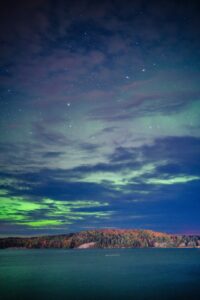
Photographing the northern lights is one of those bucket-list experiences that demands specific things from your camera, and most of them have nothing to do with megapixels. You need a sensor that handles ISO 1600-6400 without turning to noise soup, a lens mount with fast wide-angle options, and a body that won’t die in freezing temperatures. As someone who’s chased aurora across Michigan’s Upper Peninsula and the Lake Superior shoreline, I’ve learned exactly what works and what doesn’t. Here are the seven best affordable cameras for northern lights photography, all under $1,500.
Quick Picks: Top 3 for Aurora Photography
| Camera | Price | Best For |
|---|---|---|
| Nikon Z5 | ~$900 refurb | Best full-frame value for aurora |
| Sony a6700 | ~$1,400 | Best APS-C low-light performance |
| Fujifilm X-T5 | ~$1,400 | Best for high-resolution aurora prints |
Why Northern Lights Photography Is Different
Aurora photography is essentially long-exposure night photography in freezing conditions. That changes the priorities completely compared to daytime shooting. Here’s what actually matters:
- High-ISO performance: You’re shooting at ISO 1600-6400 for 5-15 second exposures. Noise performance is paramount.
- Full-frame advantage: Larger sensors collect more light per pixel. Full-frame has a real, measurable advantage for northern lights work.
- Fast wide-angle lenses: You need f/2.8 or faster in a 14-24mm equivalent range. The lens mount ecosystem matters.
- Cold weather battery life: Lithium-ion batteries lose capacity in freezing temps. Cameras with larger batteries or USB-C charging survive longer.
- Manual controls: Autofocus doesn’t work in the dark. You need easy manual focus with focus peaking and a manual exposure mode you can access quickly.
The 7 Best Affordable Cameras for Northern Lights
1. Nikon Z5 (Refurbished). Best Full-Frame Value for Aurora
The Z5 is a full-frame camera at an APS-C price, and that full-frame sensor is exactly what you want for northern lights. The 24.3MP BSI-CMOS sensor delivers clean files at ISO 3200 with minimal noise, and ISO 6400 is very usable with basic noise reduction in post. I’ve shot aurora at ISO 3200, f/2.8, 8 seconds on the Z5 and the files are clean, colorful, and detailed.
The Nikon Z-mount has excellent fast wide-angle options: the Nikon Z 20mm f/1.8 S ($1,000) is outstanding for aurora, and the more affordable Viltrox 20mm f/1.8 Z (~$350) is a budget alternative that performs surprisingly well. The Z5’s 5-axis IBIS doesn’t help with long exposures on a tripod, but it’s useful for setting up your composition handheld before locking in.
Key specs: 24.3MP full-frame BSI-CMOS, ISO 100-51,200, 5-axis IBIS, dual SD card slots, USB-C charging, weather sealed, 675g, 470 shots/charge.
- Pros: Full-frame sensor for best noise performance, weather sealed for cold conditions, dual card slots, USB-C field charging, excellent fast prime availability
- Cons: Only available refurbished at this price, slower EXPEED 6 processor, 4K video is cropped, limited new stock
- Best for: Dedicated aurora chasers who want the best low-light performance under $1,000
- Price: ~$800-$1,000 refurbished
2. Sony a6700. Best APS-C for Low Light
If you want to stay with APS-C, the a6700 has the best high-ISO performance in the crop-sensor class. Sony’s BSI-CMOS sensor technology is a generation ahead, and the BIONZ XR processor does excellent noise reduction. I’ve gotten usable aurora shots at ISO 6400 on the a6700, they require more noise reduction in post than full-frame, but the results are solid.
Sony’s E-mount has perhaps the best selection of affordable fast wide-angle primes. The Sigma 16mm f/1.4 (~$380) is an exceptional aurora lens on APS-C, giving you a 24mm equivalent field of view at f/1.4, which collects a massive amount of light. The Samyang/Rokinon 12mm f/2.0 (~$250) is another budget favorite for aurora shooters.
Key specs: 26MP APS-C BSI-CMOS, ISO 100-32,000, 5-axis IBIS, weather sealed, USB-C charging, 493g, 570 shots/charge.
- Pros: Best APS-C low-light performance, huge lens selection including budget fast primes, weather sealed, great battery life, USB-C
- Cons: APS-C sensor won’t match full-frame for noise, smaller viewfinder, menu complexity
- Best for: Photographers who want a versatile APS-C camera that also handles aurora well
- Price: ~$1,400 body only
3. Fujifilm X-T5. Best for Aurora Prints
The X-T5’s 40.2MP sensor captures extraordinary detail in aurora images, the subtle curtain structures, the star field behind them, the foreground landscape. If you plan to make large prints of your northern lights photos, those extra megapixels matter. Fuji’s dedicated manual dials make it fast to adjust settings in the dark by feel, without looking at a screen, a genuine advantage when you’re wearing gloves at -10°F.
Fuji’s XF 16mm f/1.4 ($1,000) is one of the best APS-C aurora lenses ever made. The more budget-friendly Viltrox 13mm f/1.4 for Fuji X (~$350) is an excellent alternative.
Key specs: 40.2MP APS-C X-Trans CMOS 5 HR, ISO 125-12,800, 7-stop IBIS, weather resistant, 557g, 580 shots/charge.
- Pros: 40MP for maximum aurora detail, tactile manual controls (great in the dark with gloves), weather resistant, excellent IBIS, gorgeous color
- Cons: Base ISO 125 (not 100), native ISO ceiling is 12,800, X-Trans sensor can show artifacts in raw conversion
- Best for: Photographers who want maximum resolution for large aurora prints
- Price: ~$1,400 body only
4. Nikon Z50 II. Best Budget Aurora Camera
The Z50 II gives you Nikon’s excellent color science and sensor performance at an accessible price. At ISO 3200, the files are very clean for APS-C, and the IBIS helps with framing your shots. The Z-mount gives you access to Nikon’s outstanding Z 20mm f/1.8 S via DX crop mode, or the more affordable Viltrox primes. USB-C charging means you can top up from a power bank during long aurora sessions.
Key specs: 20.9MP APS-C, ISO 100-51,200, IBIS, USB-C charging, 550g, 350 shots/charge.
- Pros: Good value at $1,050, IBIS, USB-C charging for cold weather sessions, Nikon’s color science handles green aurora beautifully
- Cons: 20.9MP limits crop potential, battery life is short in cold, APS-C noise visible at ISO 6400
- Best for: Budget-conscious aurora shooters who want a capable system
- Price: ~$1,050 body only
5. Canon EOS R8. Best Affordable Full-Frame Canon
The R8 is Canon’s lightest full-frame body at just 461g, and its 24.2MP full-frame sensor has excellent high-ISO capability. At ISO 3200 and 6400, the files are clean with natural color. Canon’s processing of the green aurora tones is particularly pleasing. The RF mount has the Canon RF 16mm f/2.8 STM at just $300, making it one of the most affordable full-frame + wide-angle combos for aurora photography.
Key specs: 24.2MP full-frame CMOS, ISO 100-102,400, DIGIC X, no IBIS, 461g, 290 shots/charge.
- Pros: Full-frame at $1,500, extremely lightweight, cheap RF 16mm f/2.8 lens option, excellent high-ISO, Canon color science
- Cons: No IBIS, poor battery life (carry spares), single SD card slot, at the top of our budget
- Best for: Canon shooters who want full-frame aurora performance in a lightweight body
- Price: ~$1,500 body only
6. Sony a7 II (Used/Refurbished). Budget Full-Frame
The a7 II is two generations old, but its 24.3MP full-frame sensor still produces excellent northern lights images. You can find these for $600-$800 used or refurbished. The 5-axis IBIS was groundbreaking when it launched and still works fine. The A-mount to E-mount adapter world opens up decades of affordable fast wide-angle glass, and native options like the Samyang 14mm f/2.8 AF (~$500) are solid aurora performers.
Key specs: 24.3MP full-frame Exmor CMOS, ISO 100-25,600, 5fps, 5-axis IBIS, 599g, 350 shots/charge.
From the Photographer
Pink Mammatus Clouds Sunset
Rare pink mammatus clouds at sunset, nature’s most dramatic sky
Zeefeldt Photography
. Fine art prints starting at $95
- Pros: Full-frame for $600-$800, 5-axis IBIS, enormous lens selection (native + adapted), proven sensor
- Cons: Older AF system, slow burst rate, poor menu ergonomics, battery life degrades in cold, micro-USB
- Best for: Budget-first photographers who want full-frame light-gathering on the cheap
- Price: ~$600-$800 used/refurbished
7. Canon EOS R10. Budget APS-C Aurora Starter
The R10 at $750 is the most budget-friendly interchangeable-lens option. Pair it with Canon’s RF 16mm f/2.8 STM ($300) and you have a full aurora kit for $1,050. The APS-C sensor means more noise at high ISO compared to full-frame, but at ISO 1600-3200 with proper noise reduction, you can get very satisfying aurora images. The crop factor turns the 16mm into a 25.6mm equivalent, which is still wide enough for most aurora compositions.
Key specs: 24.2MP APS-C, ISO 100-32,000, no IBIS, 429g, 430 shots/charge.
- Pros: Affordable kit total under $1,100, lightweight, access to Canon’s cheap RF 16mm f/2.8, easy to use
- Cons: No IBIS, APS-C noise is noticeable at ISO 3200+, no weather sealing for harsh cold, shorter battery life
- Best for: Beginners who want to try aurora photography without a big investment
- Price: ~$750 body only
Comparison Table
| Camera | Sensor | Resolution | Usable ISO Ceiling | IBIS | Weather Sealed | Price |
|---|---|---|---|---|---|---|
| Nikon Z5 | Full-Frame | 24.3MP | ISO 6400 | Yes | Yes | $900 refurb |
| Sony a6700 | APS-C | 26MP | ISO 6400 | Yes | Yes | $1,400 |
| Fujifilm X-T5 | APS-C | 40.2MP | ISO 3200 | Yes | Yes | $1,400 |
| Nikon Z50 II | APS-C | 20.9MP | ISO 3200 | Yes | Partial | $1,050 |
| Canon EOS R8 | Full-Frame | 24.2MP | ISO 6400 | No | Partial | $1,500 |
| Sony a7 II | Full-Frame | 24.3MP | ISO 6400 | Yes | Partial | $700 used |
| Canon EOS R10 | APS-C | 24.2MP | ISO 3200 | No | No | $750 |
Essential Gear Beyond the Camera
Fast Wide-Angle Lens (Required)
Your lens matters more than your camera for aurora photography. You need f/2.8 or faster in a focal length between 14-24mm (full-frame) or 10-16mm (APS-C). Budget options: Rokinon/Samyang 14mm f/2.8 ($250-$350), Canon RF 16mm f/2.8 STM ($300), Sigma 16mm f/1.4 for APS-C ($380).
Sturdy Tripod (Required)
You’re doing 5-15 second exposures. Any camera shake means blurry images. A $50-$100 aluminum tripod works fine. Make sure it’s stable in wind. Carbon fiber ($150-$300) is lighter for hiking to remote aurora spots.
Extra Batteries (Required)
Cold weather can cut battery life by 40-60%. Carry at least two extra batteries and keep them warm in an inner jacket pocket. Swap them in when the active battery weakens. Cameras with USB-C charging can use a power bank as backup.
Remote Shutter Release or Timer
Touching the camera during a long exposure introduces shake. Use a remote shutter release ($10-$20) or the camera’s built-in 2-second timer to trigger exposures hands-free.
On an even tighter budget? Our best budget camera for northern lights guide has great options under $500.
Frequently Asked Questions
What camera settings should I use for the northern lights?
Start with Manual mode, f/2.8 (or your widest aperture), ISO 1600, and a 10-second exposure. Check the result and adjust: if too dark, increase ISO to 3200 or extend exposure to 15 seconds. If the aurora is moving fast, use shorter exposures (5-8 seconds) at higher ISO to freeze the curtain structures. Focus manually on a bright star using live view magnification.
Do I need a full-frame camera for northern lights?
Not necessarily, but it helps. Full-frame sensors have larger pixels that collect more light, producing cleaner images at high ISO. APS-C cameras can absolutely shoot great aurora, you just need to be more careful with noise reduction and may need to keep ISO a stop lower. A full-frame camera at ISO 3200 looks roughly like an APS-C at ISO 2000.
Can I photograph the northern lights with my phone?
Modern flagship phones (iPhone 15 Pro, Samsung S24 Ultra, Pixel 8 Pro) can capture basic aurora images using their night mode. However, the results are heavily processed, lack the detail and dynamic range of a dedicated camera, and you have very limited control over exposure settings. A phone is fine for a personal memory; a camera is needed for images you’d want to print or share proudly.
Where can I see the northern lights in the United States?
The best spots in the US are along the northern border states: Michigan’s Upper Peninsula, northern Minnesota, Wisconsin’s Door County, Montana, and Alaska. During strong geomagnetic storms (Kp 7+), aurora can be visible as far south as Michigan’s Lower Peninsula, northern Iowa, and Oregon. Check the NOAA Space Weather Prediction Center or apps like My Aurora Forecast for real-time alerts.
What’s the best time of year for northern lights photography?
September through March offers the darkest skies and longest nights. The equinox periods (late September and late March) are statistically the most active for aurora due to the orientation of Earth’s magnetic field relative to the sun. Avoid full moon periods, moonlight washes out the aurora colors.
How do I focus the camera in the dark for aurora photography?
Switch to manual focus. Use live view with magnification (usually 5x or 10x) to zoom in on a bright star or distant light. Adjust focus until the star is the sharpest pinpoint possible. Lock your focus ring with tape so it doesn’t shift. Do NOT trust the infinity mark on your lens, it’s rarely accurate. Check and refine focus periodically throughout your session.
Final Verdict
For the best affordable camera for northern lights, the Nikon Z5 refurbished is my top recommendation. Full-frame sensor, weather sealing, dual card slots, USB-C charging, and outstanding Z-mount fast prime lenses, all for under $1,000. It’s purpose-built for this kind of work.
If you want to stay on APS-C with a versatile camera, the Sony a6700 has the best high-ISO performance in the crop-sensor world, and the Sigma 16mm f/1.4 is an incredible aurora lens for under $400.
On a tighter budget, the Canon EOS R10 paired with the RF 16mm f/2.8 STM gets you shooting aurora for about $1,050 total, hard to beat for a complete kit.
Whatever camera you choose, remember: your next clear night under a Kp 5+ forecast matters more than your gear. Get outside, set up, and shoot.
Related Guides
Browse more nature photography tutorials, gear reviews, and field tips.
Download our guide: exposure, ISO, and aperture strategies for every light condition and terrain.
We respect your inbox. One guide, occasional tips, unsubscribe anytime.